
How DAB Works
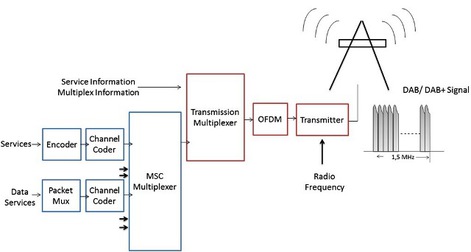
Generation of the DAB Signal Each service signal is coded individually at source level, error protected and time interleaved in the channel coder. The services are then multiplexed in the Main Service Channel (MSC), according to a pre-determined, but adjustable, multiplex configuration. The multiplexer output is combined with Multiplex Control and Service information, which travel in the fast Information Channel (FIC), to form the transmission frames in the Transmission Multiplexer. Finally, Orthogonal Frequency Division Multiplexing (OFDM) is applied to shape the DAB signal, which consists of a large number of carriers. The signal is then transposed to the appropriate radio frequency band, amplified and transmitted.
Reception of a DAB signal
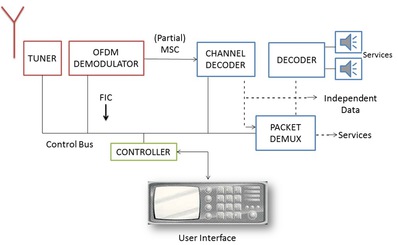
The DAB ensemble is selected in the analogue tuner., the digitised output of which is fed to the OFDM demodulator and channel decoder to eliminate transmission errors. The information contained in the FIC is passed to the user interface for service selection and is used to set the receiver appropriately. The MSC data is further processed in an audio decoder to produce the left and right audio signals or in a data decoder (Packet Demux) as appropriate.
Bitrates
DAB provides a flexible platform that permits the capacity of a DAB ensemble to be allocated with very fine granularity to the services carried. The situation is different in different countries according to national regulation, commercial issues and a host of other factors, so there is no "typical" audio bitrate. In some ensembles, the total capacity is divided equally across a number of services and each service operates at the same bit rate, whilst in others, each service provider pays according to the capacity they use and in these ensembles a large range of bit rates may be present. Bit rates for audio services (using DAB+ audio coding) are generally in the range from 40 kbps to 88 kbps, although lower and higher bitrates are also used by some services. In some cases, the "headline" bit rate may appear to be higher because additional visual content is provided using the SlideShow application - the capacity used for audio will be 8 to 16 kbps lower than the subchannel bit rate.